
UKCDA · LONDON & SURREY
Fridge repairs in London & Surrey
Fridge repairs across London, Surrey, DA and RM. Get safe cooling checks, food-storage guidance and clear call-out information before requesting a UKCDA visit.
Office hours: Monday–Saturday, 9am–7pm. Contact the team to check availability for your postcode; a visit time is agreed separately.
Read customer reviews on Checkatrade before deciding.
Independent domestic repair visits at your property: London, every address inside the M25, all Surrey and all DA and RM postcodes. Your model, full service address and appointment are confirmed by the office.
Which appliance needs help? This page covers a separate domestic fridge. For a combined appliance, choose fridge freezer repair; for a standalone upright or chest freezer, choose freezer repair.
What does the repair visit cost?
Central London freestanding call-out £90; integrated from £120; other areas from £75. Parts extra.
Samsung, LG, Miele and Smeg have separate starting rates: from £90 plus parts outside Central London, or from £120 plus parts in Central London. Integrated appliances of any brand start from £120 plus parts in Central London. The office confirms the applicable charge.
The agreed charge covers the first visit, repair labour and any return visit needed to fit parts for the same agreed repair. There is no extra labour or repeat call-out charge for that repair.
Parts are priced separately and approved before fitting. The office confirms the fixed charge for the model, fitting type and service address before arranging a visit.
After diagnosis, the agreed call-out remains payable if you decide not to proceed with the repair or the required part is unavailable.
Charges, cover and additional work
For a Central London service address, the standard freestanding call-out is £90 plus parts. Integrated appliances of any brand start from £120 plus parts in Central London. Outside Central London, fixed call-out charges start from £75, depending on your appliance's make and model and whether it is freestanding, integrated or another appliance type. Our office confirms the service address and applicable amount by phone before arranging your visit.
A different fault, another appliance, installation, removal or alterations require a separately agreed scope and quote.
If a replacement part does not resolve the fault, we do not charge you for that part. The agreed call-out still applies and is non-refundable after the diagnostic visit. This does not affect your statutory rights.
Parts-cover duration and conditions depend on the part and supplier. Ask us to confirm the cover for your repair, including any labour cover, before agreeing the work. Check any existing manufacturer or service-plan cover first; UKCDA is an independent business.
WATCH A SHORT EXPLANATION
Fridge and freezer problems explained
Cooling changes, frost and unusual noises explained without assuming the cause or whether food is safe.
Press play when you are ready. English captions are available in the player controls. Open the video file if playback is unavailable.
This general fridge-freezer overview also explains common cooling symptoms in standalone appliances. Compartments, internal layout and the required assessment differ by model.
Read the written summary
A written overview of the symptoms and next step, not a word-for-word transcript.
Poor cooling, frost and unusual noises can involve different parts of the appliance. Airflow, seals, controls and the cooling system are possible assessment areas; a working light or display does not show that food is being stored safely.
Describe the affected compartment and model. Do not open electrical covers or interfere with the refrigeration system. Stop use for smoke, burning smells or electrical tripping, and follow current Food Standards Agency advice about chilled and frozen food.
Fridge not cooling, leaking or making a new noise?
A warm fridge, water under the salad drawer and a new running noise need different checks. These observations help you decide what to report; they do not identify a failed part or confirm that food is safe.
The light works, but the fridge is warm
A working light only shows that the light has power. Check the temperature setting against your model handbook. Note whether food prevents the door closing or covers the internal air vents. Leave room between stored items for air to circulate.
A display may show the selected temperature rather than the temperature actually reached. Include a separate fridge-thermometer reading if available.
Recent loading or a door left open can affect cooling, but do not assume persistent warmth is normal or wait for a repair booking before protecting the food. Beko explains these cooling checks; the settings and layout in your own model's instructions take precedence.
Water under a drawer is different from a leak on the floor
Some fridges collect condensation at the rear wall and drain it away. Bosch identifies a blocked condensation outlet as one possible reason for water collecting inside. Follow your handbook's routine cleaning instructions only if it describes an accessible drain. Do not push tools into hidden pipework or remove panels.
Water underneath the appliance, a recurring puddle or water near electrics needs separate assessment. Do not assume a blocked drain is the cause. Read Bosch's water-build-up guidance.
Rear-wall droplets are not the same as heavy ice
On some fridge designs, a little rear-wall moisture or frost forms and clears during normal operation. Beko distinguishes this from substantial ice build-up. Check the handbook before treating every droplet as a fault. Keep food away from the rear wall where instructed, note whether the door closes properly, and report persistent heavy frost or unwanted freezing of food. Do not chip ice away. Beko's explanation of rear-wall moisture and ice is a model-dependent example, not a rule for every fridge.
Humming or gurgling can be normal; a change matters
Compressors, fans and circulating refrigerant can make normal operating sounds. Beko also describes occasional cracking as parts expand and contract. A noise alone does not prove a compressor has failed. If a sound is new, much louder or accompanied by warming, an alarm or water, describe that change and when it occurs. Do not move a fitted fridge or reach behind it to trace the sound. Compare Beko's normal-noise examples with your model handbook.
Safe checks and food protection before booking
- Look at the settings, accessible door seal and stored items without dismantling anything. Leave external ventilation clear as the manufacturer specifies; there is no universal clearance for every freestanding and integrated model.
- Do not remove covers, disturb refrigeration pipework or use sharp tools or applied heat to clear ice. Do not pull out a heavy fridge to find its label.
- Stop using an appliance that smells burnt or trips the electricity. If the plug, controls or wiring are wet, do not touch them; isolate using an accessible dry switch only if safe. Do not keep resetting a tripping supply.
The Food Standards Agency recommends a fridge temperature of 0–5°C and checking with a fridge thermometer. Follow food-label storage instructions and protect chilled food separately from arranging the repair. A lit display, cool-feeling shelf or restored cooling does not establish how the food was stored while the fault developed. Read the FSA's chilling and food-storage advice.
If there has been a power cut, keep the door closed as much as possible and follow the FSA's power-cut guidance. Its timing guidance is not a fresh safe-storage allowance starting when you notice a breakdown. A repair enquiry cannot confirm the safety of the contents.
Fridge type, model and fitting details
This page is for a separate domestic fridge: tall, under-counter, freestanding or integrated. Mention a small internal ice box, water dispenser or unusual layout. Give the full model and serial or product reference from safely accessible paperwork or the label, plus the exact alarm and when cooling changed. Find the model reference without moving the appliance.
For an integrated fridge, mention the furniture door, any recent hinge or kitchen adjustment and restricted access. Leave the appliance and furniture panels in position. Specialist domestic refrigeration needs an individual suitability check; commercial refrigeration repairs and installations are not currently accepted.
- Separate fridge: use this enquiry and describe the affected shelves or fresh-food compartment.
- Combined fridge and freezer: use fridge freezer repairs, including American-style appliances, and explain whether one or both compartments are affected.
- Separate freezer: use freezer repairs for an upright or chest freezer.
Repair the fridge or arrange a replacement?
Check any manufacturer warranty or existing repair cover before agreeing independent paid work. UKCDA is independent. The assessment, appliance condition and suitable parts determine the repair options; age, an error code or a noise alone is not enough to decide. No successful repair or first-visit completion is promised.
Replacement fitting is a separate request. Compare the proposed fridge's dimensions, ventilation requirements and connections, not just its stated capacity. For an integrated model, include the cabinet opening and fixed or sliding furniture-door arrangement. Mention door reversal, a water connection, delivery access and whether removal is needed. Read the fridge installation preparation; fitting, removal and alterations require a separately agreed scope.
Fridge repair booking questions
Can you guarantee an urgent visit or save the food?
No. Tell the office that cooling has failed so it can check available appointments, but an online request is not a confirmed visit. Protect food using the FSA guidance regardless of appointment availability.
Does a warm fridge mean it needs refrigerant or a new compressor?
No specific repair can be established from warmth alone. Send the exact model and symptoms; the office checks whether the required work is within scope before accepting the job. Do not open the cooling circuit or arrange parts based only on an online symptom list.
What should a landlord or tenant include?
Provide the complete service postcode, the person who can give access and who can authorise charges. Include the model, symptoms and fitting details if available. The office confirms the work, applicable charge and appointment before the visit.
How long does a fridge repair take?
There is no single repair time we can promise from a warm-fridge symptom. The fault assessment, access and work required determine the time on site. Ask the office about the available appointment window; an arrival window is not a promise that the repair will be completed within it.
Could the repair need a second visit?
Yes, if a suitable replacement part needs to be obtained or further agreed work is needed. The full model helps check availability, but a stock date or first-visit completion cannot be promised before assessment. The agreed charge covers the first visit, repair labour and any return visit needed to fit parts for the same agreed repair. There is no extra labour or repeat call-out charge for that repair. Parts are priced separately and approved before fitting. A different fault or separate work needs its own agreement.
Will the fridge be cold as soon as the work is finished?
Not necessarily. Completing the repair and reaching the operating temperature are different stages. Ask the engineer what to expect for your model and the work carried out, when to check the temperature, and when to contact the team if cooling does not recover. Do not treat a working light or the selected display setting as proof that the compartment has cooled.
Cooling recovery does not establish whether food affected by the original fault is safe. Follow the Food Standards Agency's food-storage guidance independently of the repair appointment. Contact UKCDA with your booking details for questions after a visit.
VISITS TO YOUR HOME OR RENTAL PROPERTY
Looking for fridge repair near you?
UKCDA takes domestic repair enquiries across London, every address inside the M25 and A282 loop, all of Surrey, and every DA and RM postcode. DA/RM addresses outside the motorway are included. These are service areas, not branches in each town.
Send your complete postcode and appliance model. For flats, include entry arrangements, stairs or lifts and parking restrictions. For rentals, add the visit contact and who can authorise the work. We check the address, suitable expertise and availability before confirming a visit.
Check your full postcode in our service-area checker. A coverage result does not reserve a visit or guarantee same-day attendance.
Choose guidance for your appliance brand
Choose guidance for your make and model. Similar symptoms or codes can mean different things on other makes. UKCDA is independent; brand names do not imply manufacturer authorisation.
Brand and model repair guides
- Bosch fridge repairs
- NEFF fridge repairs
- Siemens fridge repairs
- Hotpoint fridge repairs
- Beko fridge repairs
- Miele fridge repairs
- AEG fridge repairs
- Candy fridge repairs
- Hisense appliance overview
- Lamona appliance overview
- CDA appliance overview
- Caple appliance overview
- Blomberg appliance overview
- Grundig appliance overview
- Sharp appliance overview
- Baumatic appliance overview
- De Dietrich appliance overview
- Fisher & Paykel appliance overview
- Liebherr appliance overview
- Fridgemaster appliance overview
- Amica appliance overview
- Montpellier appliance overview
- White Knight appliance overview
- Bush appliance overview
- Logik appliance overview
- Kenwood appliance overview
- Currys Essentials appliance overview
- John Lewis appliance overview
- IKEA appliance overview
What happens after you send the enquiry?
- The office checks the details. We review the appliance, fault, address and access. A symptom alone cannot confirm a repair.
- Agree the visit and charge. We confirm the applicable fixed call-out and appointment. Check existing manufacturer or service-plan cover before arranging independent paid work.
- The assessment establishes the options. We quote any required parts for approval before fitting. First-visit completion depends on the fault and suitable parts; it is not guaranteed.
The form starts an enquiry, without taking payment or confirming a time slot. For urgent availability, call 07474 369490. Before agreeing the visit, ask about charges if repair is not possible and cover for the proposed work.
UNDERSTAND YOUR DISPLAY
Manufacturer error-code guidance
Choose the exact brand, appliance and message. A code describes a detected condition; it does not confirm a failed part. Check the complete model against the linked manufacturer guidance. For an unlisted message, use “Find appliance help” above or send your model and question privately.
Caple RIL1800 fridge: E01–E07 sensor warning
Model check: Caple RIL1800 fridge only; manual page 30.
The Caple RIL1800 manual groups E01 to E07 as sensor warnings requiring service assistance. It does not identify a replacement component from the displayed number alone.
Caple RIL1800 fridge: E08 supply-voltage warning
Model check: Caple RIL1800 fridge only; manual page 30.
For the Caple RIL1800, E08 warns of low supply voltage. It is a protective warning, not proof the fridge has failed. Persistent warnings need professional assessment; do not test wiring yourself.
Caple RIL1800 fridge: E10 temperature too warm
Model check: Caple RIL1800 fridge only; manual page 30.
The Caple RIL1800 uses E10 when its compartment is not cold enough. Record any recent power interruption and arrange assessment if the warning continues. A temperature warning does not identify a failed part.
Caple RIL1800 fridge: E11 temperature too cold
Model check: Caple RIL1800 fridge only; manual page 30.
For the Caple RIL1800, E11 means the fridge compartment is too cold. Note the settings and whether Super Cool is active. Persistent overcooling needs assessment against this model's instructions.
Leave electrical covers and fitted components in place. Stop using an appliance that leaks, overheats, smells burnt or trips the electrics. UKCDA is independent; check any manufacturer guarantee before arranging a paid visit.
PREPARING YOUR REQUEST
Prepare the details safely.
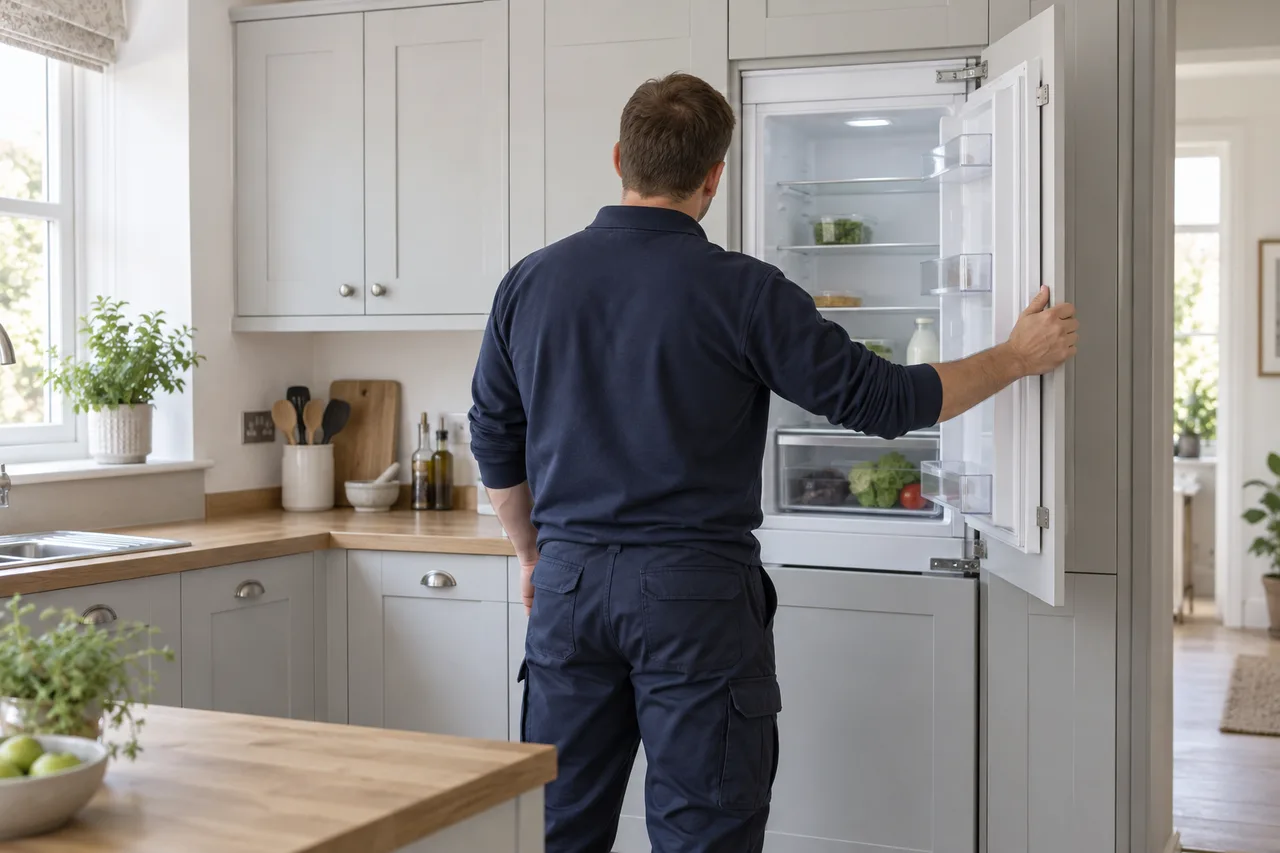
Send the full model and describe which compartment is affected. Mention a fitted furniture door, water connection or restricted access where relevant. Leave heavy appliances and internal panels in place.
What to include in your enquiry →